Backhaul basics
A carrier-oriented look at how return lanes and repositioning change truck economics, with attention to empty miles, appointment pressure, cost exposure, and the next move after delivery.
Written and reviewed by LaneMath Editorial Team, with carrier workflow review from Dale Morrow where practical dispatch, paperwork, or lane-planning context is involved. Updated 2026-06-29. LaneMath pages use public references, example-only math, and conservative editorial review.
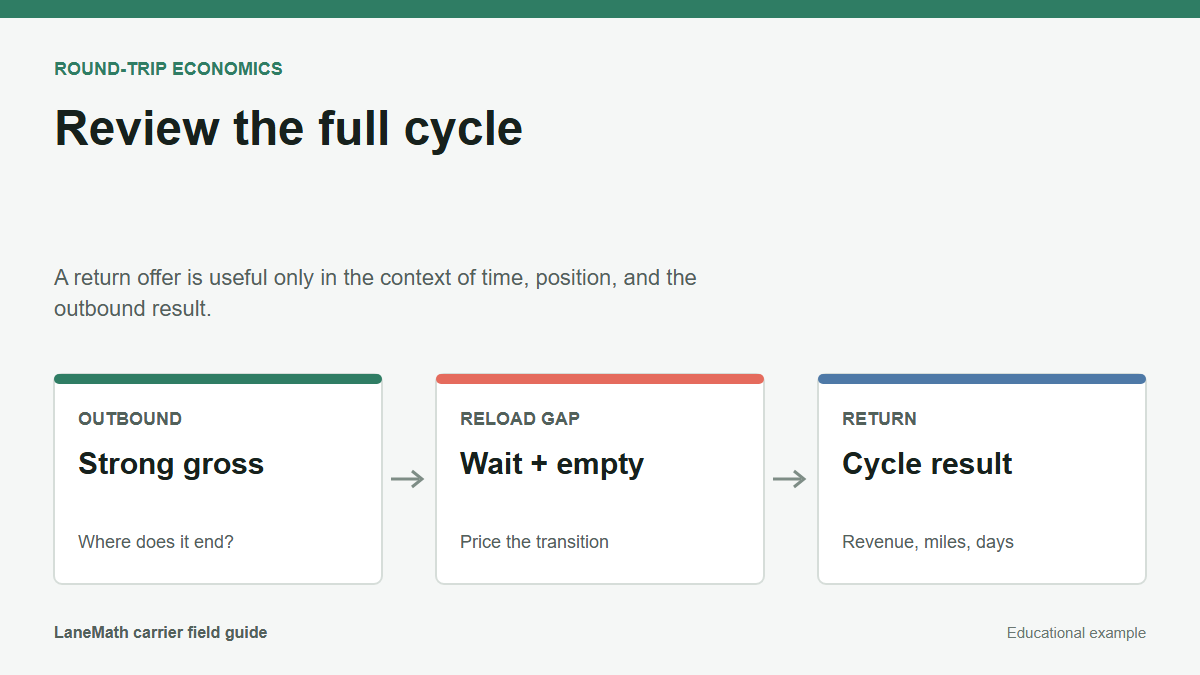
Backhaul choices after delivery
A backhaul decision balances exit speed, revenue, direction, and the position created by the next delivery.
| Signal | Why it matters | Next check |
|---|---|---|
| Many loads are posted | Volume may include unsuitable equipment, payment, or pickup timing. | Filter for freight the truck can legally and practically use. |
| First return offer is low | Waiting may improve rate or may add another idle day. | Compare the possible increase with parking and time cost. |
| Reload moves toward home | Direction can have value even when gross is lower. | Measure the full cycle and note the home-time benefit separately. |
| Reload enters another weak market | Leaving one difficult destination can create a second repositioning problem. | Check the next delivery area before accepting the exit load. |
Key takeaways
- Check freight density before assuming the return is easy.
- Compare the whole round trip, not one direction only.
- Watch delivery markets that require long empty moves to reload.
Working frame for backhaul basics
A carrier-oriented look at how return lanes and repositioning change truck economics, with attention to empty miles, appointment pressure, cost exposure, and the next move after delivery. The first operating question is whether the subject changes money, time, equipment fit, payment exposure, or the truck's position after delivery. Keep those effects separate so one attractive number does not hide an unresolved condition.
Checks before the truck is committed
Check freight density before assuming the return is easy. Compare the whole round trip, not one direction only. Watch delivery markets that require long empty moves to reload. Write down any term that still depends on a broker reply before dispatch. Confirm the exact commodity, weight, equipment, appointments, facility rules, and approval path that apply to this load rather than relying on a familiar lane or broker relationship.
Operating note
A backhaul review starts after delivery, not at the original pickup. The carrier is asking whether the destination market offers usable freight for the truck's equipment, driver hours, home-time plan, and payment standards. A backhaul can be acceptable at a lower gross number if it protects the next move, but it can also become expensive when the truck must chase freight far from the receiver. Treat the return direction as its own business decision instead of assuming it balances the outbound lane.
What freight is usable after delivery?
Look beyond the number of postings around the destination. Ask whether those loads fit the trailer, driver hours, payment standards, and direction the truck needs to travel. A market with many unsuitable partials or late pickups is not a strong backhaul market for that truck.
The return load does not have to mirror the outbound
Carriers sometimes expect the same mileage, rate, and timing in both directions. Freight production and consumption are rarely balanced that neatly. Holding out for an outbound-style rate can cost more in idle time than accepting a workable repositioning load, while taking the first cheap return can lock the truck into another weak market.
Review the round trip, not just the return
Keep gross revenue, total miles, calendar time, and direct trip costs for both directions. Note any idle day or long empty move between them. A backhaul record is most useful when it shows whether the full cycle returned the truck to a productive position at an acceptable result.
Example scenario
The outbound load pays well into South Florida, but the first northbound offer requires a long wait and delivers away from the carrier's next customer. A lower-gross load leaving sooner may protect the round trip. The decision should compare the full cycle rather than judge the return offer by itself. The numbers and circumstances are educational examples; replace them with the actual route, written terms, costs, and operating limits for the load being considered.
What to check before booking
- Check freight density before assuming the return is easy.
- Compare the whole round trip, not one direction only.
- Watch delivery markets that require long empty moves to reload.
- Write down any term that still depends on a broker reply before dispatch.
Common questions
What makes a lane a backhaul versus a headhaul?
A headhaul lane typically has stronger freight demand, better rate-per-mile potential, and more available loads. A backhaul lane goes in the direction of lower freight density, often producing lower rates and fewer options. Which direction is stronger depends on the specific market and season, not just geography.
Is a backhaul load worth taking?
It depends on the alternative. A backhaul that avoids a long empty repositioning, keeps the truck productive, or positions it for a stronger headhaul is often worth considering. One that barely covers fuel, requires extra compliance steps, or blocks a nearby better option is harder to justify.
What is the minimum rate a carrier should accept on a backhaul to avoid losing money?
At minimum, a backhaul should cover out-of-pocket trip cost — fuel, tolls, parking, any out-of-pocket accessorials — and ideally contribute toward fixed costs and time. A load that covers only fuel is not profitable; it is a way to reposition cheaply. Whether that trade-off makes sense depends on how far the truck would otherwise run empty and what comes after the backhaul delivers.
How does season affect which direction on a corridor is the headhaul?
Freight direction and density shift with demand patterns. Agricultural lanes, retail shipping cycles, and industrial production schedules all create seasonal directional imbalances. A lane that runs strong eastbound in the fall may weaken in winter while the opposite direction improves. Carriers who work regular corridors benefit from tracking how their specific lanes change across the year rather than assuming the headhaul direction stays fixed.
References and methodology
- Operational Costs of Trucking - American Transportation Research Institute. Used here for: Per-mile carrier operational cost context for educational rate, fuel, and profitability examples.Annual industry report used for general cost-structure background. Not a source for lane-specific rates or broker pricing. Last checked 2026-06-29.
- Freight Management and Operations - Federal Highway Administration. Used here for: Federal highway freight route, corridor planning, and infrastructure context for lane economics and routing discussions.Used for general freight infrastructure and route context only. Not a source for market rates, lane pricing, or broker data. Last checked 2026-06-29.
- Lane planning methodology - LaneMath Editorial Desk. Used here for: Example-only lane economics, deadhead questions, accessorial checks, and planning prompts.Methodology source for practical examples. It is not freight pricing data, load board data, or a broker quote source. Last checked 2026-06-29.