Fuel surcharge basics
A plain-English guide to how fuel surcharge examples work and why written terms matter, with conservative examples and carrier-side checks that can be used before booking freight.
Written and reviewed by LaneMath Editorial Team, with carrier workflow review from Dale Morrow where practical dispatch, paperwork, or lane-planning context is involved. Updated 2026-06-29. LaneMath pages use public references, example-only math, and conservative editorial review.
Fuel surcharge input table
A surcharge can be reproduced only when every input and its effective date remain in the load file.
| Signal | Why it matters | Next check |
|---|---|---|
| Index is named | The region and weekly effective date still determine the value. | Save the exact published price used. |
| Base price is stated | The surcharge generally applies only to the spread above the base. | Confirm the base belongs to this agreement. |
| MPG assumption is fixed | A different MPG changes the per-mile result even with the same diesel price. | Use the written contractual assumption, not fleet MPG. |
| Payable miles differ | Broker miles and route miles can produce different surcharge totals. | Identify the mileage source used by the formula. |
Key takeaways
- Ask whether fuel is included in the all-in rate.
- Review the base fuel price, index reference, MPG assumption, and miles used.
- Do not treat an example formula as a tariff or live fuel quote.
Working frame for fuel surcharge basics
A plain-English guide to how fuel surcharge examples work and why written terms matter, with conservative examples and carrier-side checks that can be used before booking freight. The first operating question is whether the subject changes money, time, equipment fit, payment exposure, or the truck's position after delivery. Keep those effects separate so one attractive number does not hide an unresolved condition.
Checks before the truck is committed
Ask whether fuel is included in the all-in rate. Review the base fuel price, index reference, MPG assumption, and miles used. Do not treat an example formula as a tariff or live fuel quote. Write down any term that still depends on a broker reply before dispatch. Confirm the exact commodity, weight, equipment, appointments, facility rules, and approval path that apply to this load rather than relying on a familiar lane or broker relationship.
Operating note
Fuel surcharge mechanics matter most when comparing offers with different structures. An all-in rate of $3.50 per mile and a linehaul-plus-surcharge quote of $2.80 linehaul plus $0.60 surcharge are not the same calculation. One is the total rate already built; the other depends on whether the surcharge formula tracks diesel changes or stays fixed at booking. When diesel prices shift significantly, the difference between a locked surcharge and an indexed one can change the effective rate. The EIA weekly regional price is the most common baseline reference; some brokers use it directly, others use their own internal tables. Before signing, confirm whether the number on the confirmation reflects current diesel or is set at dispatch.
What formula produced the surcharge?
Ask for the diesel index, region, effective date, base fuel price, MPG assumption, and mileage source. Confirm whether the surcharge floats until shipment, locks at booking, or is already included in an all-in rate. A number without its formula cannot be checked later.
A fuel line is not automatically fuel protection
A fixed surcharge may not change when diesel moves, and an indexed formula may use different miles from the carrier's route. Another mistake is adding a sample LaneMath calculation to an all-in broker offer as if it were extra revenue. Written load terms decide what is actually paid.
Save the index date and formula
Keep the confirmation, cited index value, base price, MPG, mileage, and calculation used for the quote. If the amount changes before pickup, retain the revision. This allows billing to reproduce the surcharge without relying on a diesel price viewed weeks later.
Example scenario
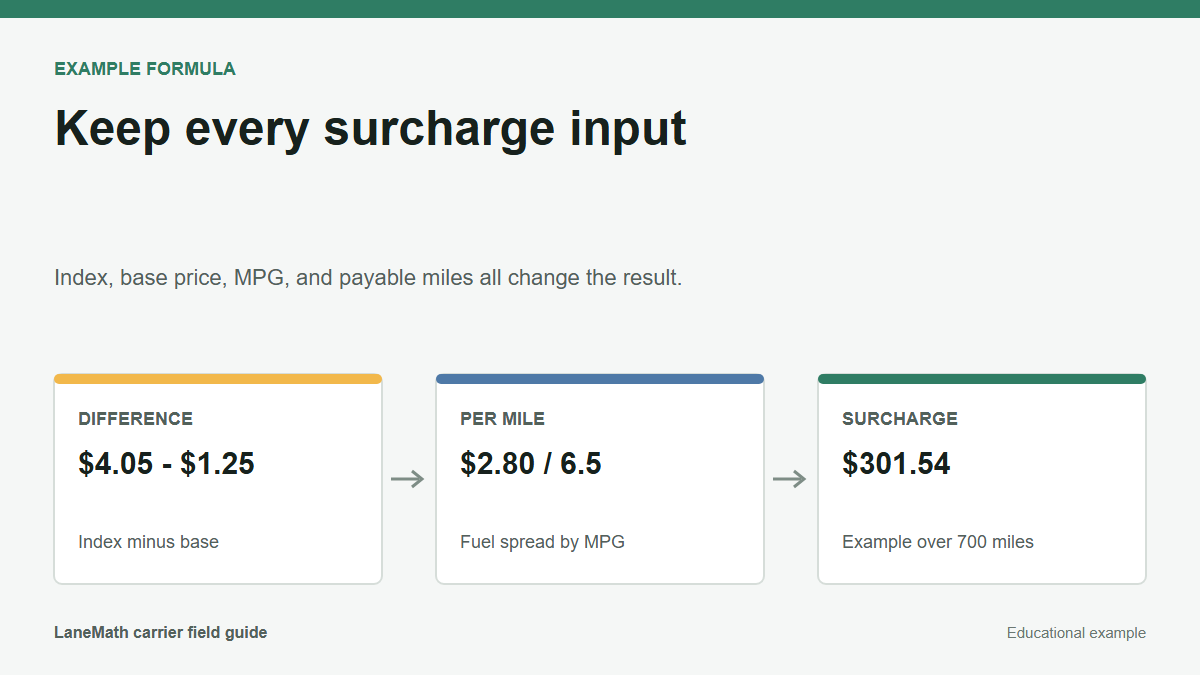
A formula uses a $1.25 base, $4.05 index, 6.5 MPG, and 700 payable miles. The example surcharge is about $301.54. If the broker uses 650 miles or a different weekly index, the result changes, so the carrier should verify the written inputs. The numbers and circumstances are educational examples; replace them with the actual route, written terms, costs, and operating limits for the load being considered.
What to check before booking
- Ask whether fuel is included in the all-in rate.
- Review the base fuel price, index reference, MPG assumption, and miles used.
- Do not treat an example formula as a tariff or live fuel quote.
- Write down any term that still depends on a broker reply before dispatch.
Common questions
Is the fuel surcharge always a separate line item?
Not always. Some broker offers quote an all-in rate that already includes fuel. Others quote a linehaul rate plus a separate fuel surcharge calculated from an index or formula. The rate confirmation should clarify which structure applies. Carriers should ask whether fuel is included before comparing offers with different formats.
Does LaneMath show live fuel surcharge rates?
No. LaneMath uses example-only fuel surcharge math to explain how the formulas work. The EIA publishes weekly national and regional diesel prices that carriers can use as a reference when estimating trip fuel cost.
What is the EIA index and how is it used in fuel surcharge calculations?
The Energy Information Administration publishes weekly national and regional diesel retail prices. Many broker fuel surcharge formulas use the EIA national average as a base reference, subtracting a floor price and dividing by an assumed MPG figure to produce a per-mile surcharge. The exact formula and floor price vary by broker, so the written terms in the rate confirmation are the only reliable guide for a specific load.
Why might the fuel surcharge on the confirmation be different from my actual fuel cost on the trip?
Broker fuel surcharges are typically formula-based estimates using a national or regional diesel index and an assumed MPG. Your actual fuel cost depends on route, driving conditions, truck MPG, and current pump prices in the specific areas where the truck fuels. The two numbers are not designed to match exactly; the carrier's own fuel cost estimate is the number that matters for the load decision.
References and methodology
- Gasoline and Diesel Fuel Update - U.S. Energy Information Administration. Used here for: Diesel price context for educational fuel surcharge examples.LaneMath tools do not pull live EIA data. Last checked 2026-06-29.
- Industry terminology and editorial explanation - LaneMath Editorial Desk. Used here for: Plain-English definitions, checklists, and example-only calculations.Editorial explanations are not official guidance, legal advice, or market data. Last checked 2026-06-29.