Rate per mile vs profit per mile
A carrier-oriented look at why gross rate is only a starting point for load selection, with attention to empty miles, appointment pressure, cost exposure, and the next move after delivery.
Written and reviewed by LaneMath Editorial Team, with carrier workflow review from Dale Morrow where practical dispatch, paperwork, or lane-planning context is involved. Updated 2026-06-29. LaneMath pages use public references, example-only math, and conservative editorial review.
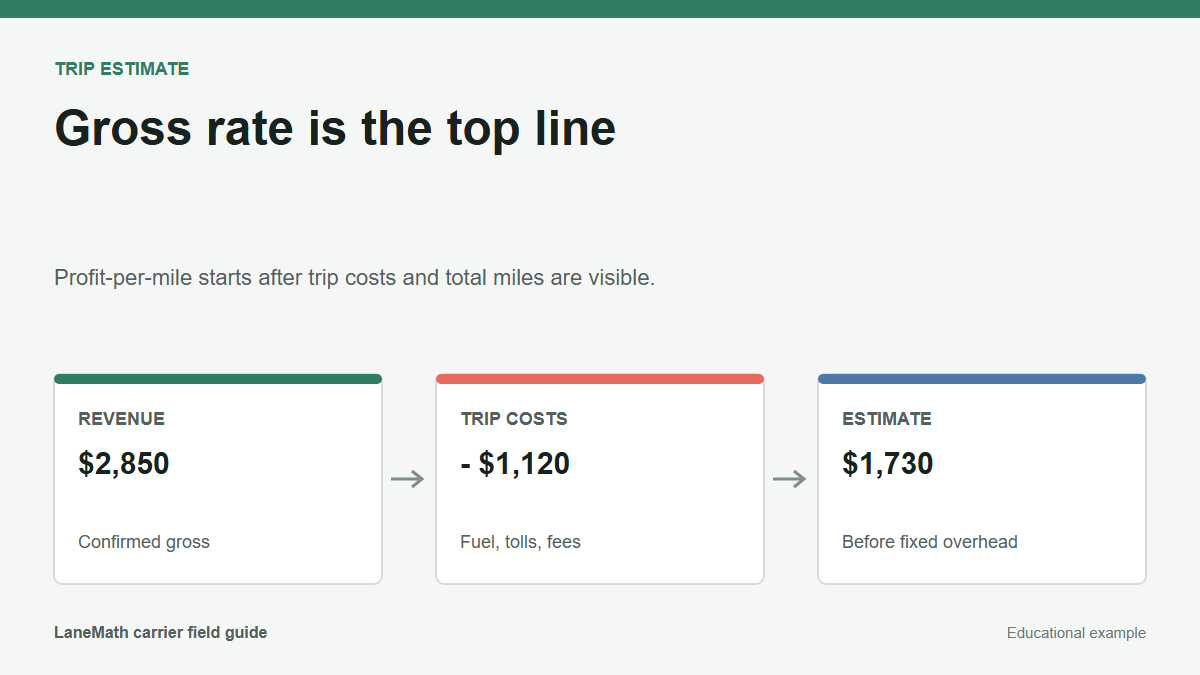
Profit estimate inputs
A profit-per-mile estimate should show which values are known, estimated, and outside the trip calculation.
| Signal | Why it matters | Next check |
|---|---|---|
| Gross rate is confirmed | Revenue is the cleanest input but still depends on included charges. | Use the final written rate and approved extras. |
| Fuel is estimated | Price, route, weight, and MPG can all move the result. | Record the price and MPG assumption rather than only the fuel total. |
| Accessorial is possible | A charge may be payable, denied, or advanced out of pocket. | Keep uncertain accessorials outside confirmed revenue. |
| Final empty miles are unknown | Profit per mile changes when the truck must reposition. | Calculate a reasonable low and high mileage case. |
Key takeaways
- Subtract fuel, tolls, lumper advances, and other trip costs.
- Use total miles for profit-per-mile estimates.
- Consider time at shipper and receiver, not just distance.
Working frame for rate per mile vs profit per mile
A carrier-oriented look at why gross rate is only a starting point for load selection, with attention to empty miles, appointment pressure, cost exposure, and the next move after delivery. The first operating question is whether the subject changes money, time, equipment fit, payment exposure, or the truck's position after delivery. Keep those effects separate so one attractive number does not hide an unresolved condition.
Checks before the truck is committed
Subtract fuel, tolls, lumper advances, and other trip costs. Use total miles for profit-per-mile estimates. Consider time at shipper and receiver, not just distance. Write down any term that still depends on a broker reply before dispatch. Confirm the exact commodity, weight, equipment, appointments, facility rules, and approval path that apply to this load rather than relying on a familiar lane or broker relationship.
Operating note
Rate per mile is a revenue shortcut; profit per mile is an operating estimate. The second number needs fuel, tolls, lumpers, paid or unpaid wait time, factoring or quick-pay cost, and total miles. This topic is useful when two loads have similar gross rates but different time exposure. A shorter load with a slow receiver may earn less useful profit than a longer load with cleaner appointments and a better reload position.
When profit per mile changes the decision
Profit per mile is most useful when two loads look close. One may pay better per loaded mile, while the other has cleaner appointments, lower out-of-pocket cost, and a better reload. The answer does not need to be perfect. It needs to be honest enough to stop a high gross number from hiding a bad operating day.
Which costs change because of this trip?
Start with fuel, tolls, parking, lumpers, permits, and payment fees that can be tied to the load. Then consider time and total miles. Fixed business costs matter to the company, but mixing them casually with trip costs can make two dispatchers calculate profit per mile differently.
A precise answer can be falsely precise
Profit per mile is an estimate before the trip closes. Fuel price, route, dwell, and the next empty move can all change. Reporting the result to the cent without showing assumptions creates more confidence than the inputs support. Use a range when important costs or delivery-side miles are still uncertain.
Keep assumptions beside the result
Save gross revenue, total planned miles, fuel assumption, toll estimate, known trip expenses, and any payment fee. After settlement, compare planned and actual values. The calculation becomes a management tool when the carrier can see why the estimate missed, not merely whether it missed.
Example scenario
Two loads both show $3.10 per loaded mile. One requires 140 empty miles, $118 in tolls, and a late unload; the other starts nearby and delivers beside the next pickup area. Their profit-per-mile estimates should not be close simply because the broker's loaded-mile numbers match. The numbers and circumstances are educational examples; replace them with the actual route, written terms, costs, and operating limits for the load being considered.
What to check before booking
- Subtract fuel, tolls, lumper advances, and other trip costs.
- Use total miles for profit-per-mile estimates.
- Consider time at shipper and receiver, not just distance.
- Write down any term that still depends on a broker reply before dispatch.
Common questions
Why can a high rate per mile still be a weak load?
A high gross rate can be weakened by fuel, tolls, long waits, unpaid miles, lumper advances, weak accessorial terms, or a poor reload position after delivery.
What should be subtracted before estimating profit?
Start with trip-level costs such as fuel, tolls, parking, known fees, out-of-pocket accessorials, quick-pay or factoring costs when relevant, and other operating costs the carrier tracks.
How often should a carrier recalculate profit per mile to keep the estimate accurate?
Fuel prices, toll routes, and operating costs shift often enough that relying on a number from three months ago can misrepresent the current decision. Carriers who review their cost inputs each month tend to catch when a lane that used to work has quietly stopped covering expenses.
Should profit per mile include truck payment or lease costs?
That depends on how the carrier structures its analysis. Fixed monthly costs like truck payments can be allocated per mile based on expected monthly mileage, giving a fully loaded profit estimate. Some carriers track them separately as overhead. Either approach works as long as the method is consistent across comparisons.
References and methodology
- Operational Costs of Trucking - American Transportation Research Institute. Used here for: Per-mile carrier operational cost context for educational rate, fuel, and profitability examples.Annual industry report used for general cost-structure background. Not a source for lane-specific rates or broker pricing. Last checked 2026-06-29.
- Industry terminology and editorial explanation - LaneMath Editorial Desk. Used here for: Plain-English definitions, checklists, and example-only calculations.Editorial explanations are not official guidance, legal advice, or market data. Last checked 2026-06-29.