Spot rate vs contract rate
A plain-English guide to the difference between one-off market freight and longer-term pricing agreements, with conservative examples and carrier-side checks that can be used before booking freight.
Written and reviewed by LaneMath Editorial Team, with carrier workflow review from Dale Morrow where practical dispatch, paperwork, or lane-planning context is involved. Updated 2026-06-29. LaneMath pages use public references, example-only math, and conservative editorial review.
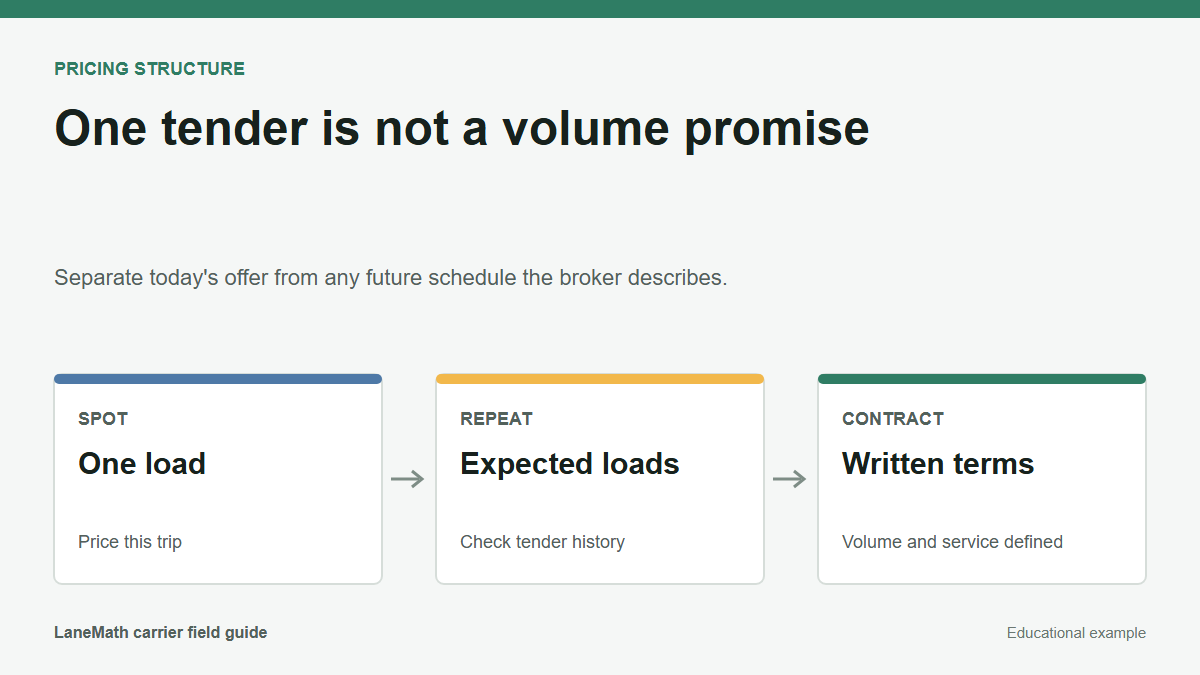
Spot and recurring-freight checkpoints
A repeat lane can still be a series of spot transactions. These signals help identify what, if anything, has actually been committed.
| Signal | Why it matters | Next check |
|---|---|---|
| Broker says freight is steady | Expected volume is not the same as a written minimum or tender schedule. | Ask what volume, days, and notice are committed. |
| Lower rate is requested for consistency | The carrier may be giving a discount before receiving predictable freight. | Compare the discount with actual tender history. |
| Service rules stay the same | Repeated appointments and tracking duties can create an operating pattern worth measuring. | Review several weeks of dwell, rejections, and reload results. |
| One tender is canceled | The arrangement may not explain cancellation, capacity, or make-up volume. | Use the written terms for that load and do not assume a future replacement. |
Key takeaways
- Ask whether the posted offer is spot freight or tied to a contract customer.
- Review service requirements before assuming the rate tells the whole story.
- Treat any sample number as a teaching example, not a market quote.
Working frame for spot rate vs contract rate
A plain-English guide to the difference between one-off market freight and longer-term pricing agreements, with conservative examples and carrier-side checks that can be used before booking freight. The first operating question is whether the subject changes money, time, equipment fit, payment exposure, or the truck's position after delivery. Keep those effects separate so one attractive number does not hide an unresolved condition.
Checks before the truck is committed
Ask whether the posted offer is spot freight or tied to a contract customer. Review service requirements before assuming the rate tells the whole story. Treat any sample number as a teaching example, not a market quote. Write down any term that still depends on a broker reply before dispatch. Confirm the exact commodity, weight, equipment, appointments, facility rules, and approval path that apply to this load rather than relying on a familiar lane or broker relationship.
Operating note
Spot freight is a single transaction; contract freight is a relationship tool. When evaluating a spot load, the question is whether the individual economics justify this trip. When evaluating a contract-type arrangement, the question shifts to whether the lane works week over week — whether it produces consistent revenue, predictable planning, and reload patterns that fit the carrier's equipment and home base. Most small carriers operate primarily on spot freight because contract business typically requires a service track record and dispatch consistency that takes time to build. The practical difference shows up in how to quote and plan: spot requires a fast one-load decision; contract-type work requires understanding the lane in both directions across seasons.
Is this one load or a repeat commitment?
Clarify whether the offer covers a single spot move, a short series, or freight the broker expects the carrier to cover on a schedule. Ask what happens when volume drops, appointments change, or the carrier cannot cover a particular day. A recurring promise without written volume or service terms should not be priced like guaranteed work.
Regular freight is not automatically contract freight
A broker may call a lane consistent because it posts several times a week. That does not create a contract rate, minimum volume, or reserved capacity agreement. The carrier can get into trouble by discounting today's truck on the assumption that future loads will make up the difference when those future loads are not committed.
Keep the offer history separate
For spot freight, retain the confirmation and the facts for that move. For a recurring arrangement, also keep the lane schedule, expected volume, service requirements, cancellation terms, and each rate revision. A simple week-by-week record makes it easier to see whether the lane behaves like the arrangement that was originally described.
Example scenario
A broker offers three Atlanta to Dallas loads each week and asks for a lower rate because the freight is described as steady. The carrier should compare the reduced rate with actual tender history and ask whether any weekly volume is committed. Until that is written, each tender still carries spot-market uncertainty. The numbers and circumstances are educational examples; replace them with the actual route, written terms, costs, and operating limits for the load being considered.
What to check before booking
- Ask whether the posted offer is spot freight or tied to a contract customer.
- Review service requirements before assuming the rate tells the whole story.
- Treat any sample number as a teaching example, not a market quote.
- Write down any term that still depends on a broker reply before dispatch.
Common questions
What is the main difference between spot freight and contract freight for a carrier?
Spot freight is offered on the open market for a single load at a price the broker or shipper sets at that moment. Contract freight typically involves a longer-term arrangement with more predictable volume and rate structure. Carriers with new authority usually start on spot loads, while established carriers may earn contract-type relationships through consistent service history.
Is the contract rate always higher than the spot rate?
Not necessarily. Contract rates offer predictability, but spot rates can run higher during periods of tight truck supply. The tradeoff is consistency versus market variability, not a guaranteed rate difference on any given day.
When a broker calls a lane 'consistent,' does that mean it is a contract rate?
No. A broker describing a lane as consistent is characterizing posting frequency, not making a volume commitment. Without a written agreement specifying minimum loads per period, rate terms, and service expectations, the arrangement is still spot freight regardless of how often the lane appears on the board.
What should a carrier ask for in writing before agreeing to a discounted rate in exchange for volume?
Ask for the specific minimum load volume per week or month, the rate or rate structure, the service requirements, and what happens if volume is not tendered as promised. Without those specifics in writing, a verbal volume promise is not enforceable, and the carrier has effectively accepted a lower rate without a guarantee.
References and methodology
- Broker Registration - Federal Motor Carrier Safety Administration. Used here for: Broker authority and registration background.Used as a public reference for broker basics. Last checked 2026-06-29.
- Industry terminology and editorial explanation - LaneMath Editorial Desk. Used here for: Plain-English definitions, checklists, and example-only calculations.Editorial explanations are not official guidance, legal advice, or market data. Last checked 2026-06-29.