Broker questions to ask before booking freight
A practical risk review for the specific broker-call questions that clarify money, appointments, equipment, paperwork, and approval rules, written for carriers that need cleaner broker checks and billing records before committing a truck.
Written and reviewed by LaneMath Editorial Team, with carrier workflow review from Dale Morrow where practical dispatch, paperwork, or lane-planning context is involved. Updated 2026-06-29. LaneMath pages use public references, example-only math, and conservative editorial review.
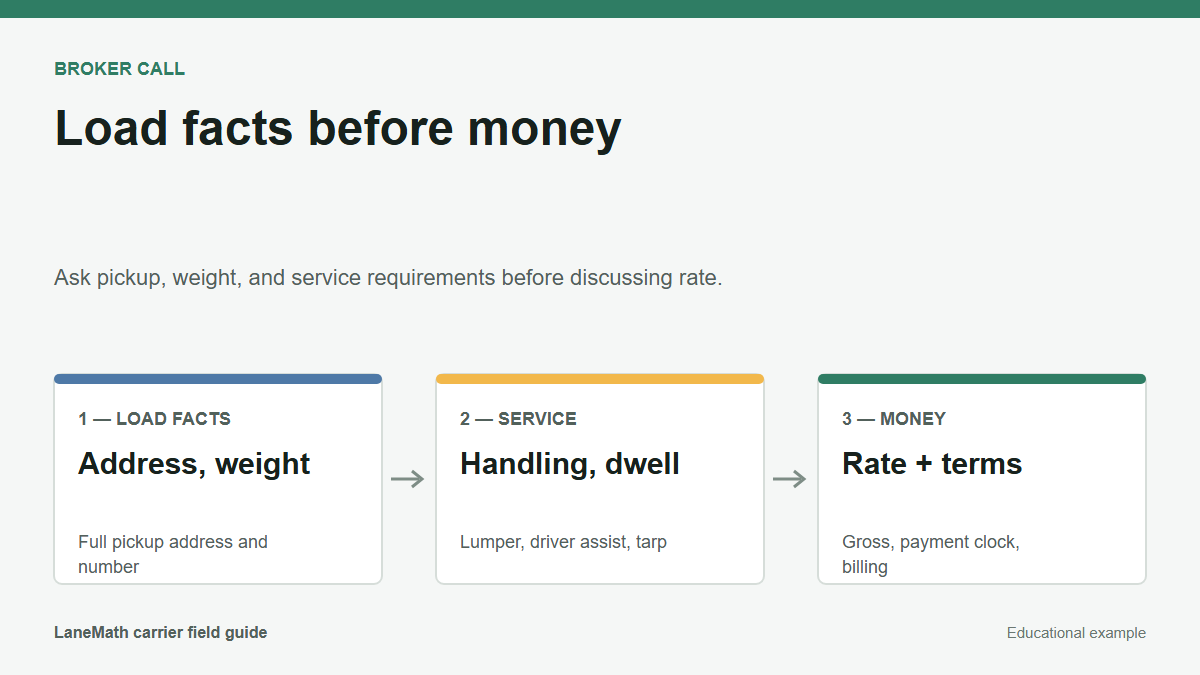
Pre-booking question priority table
Questions should move from load basics to service requirements to money, not the other way around.
| Signal | Why it matters | Next check |
|---|---|---|
| Pickup address is city-only | City labels can hide approach miles and facility access details. | Ask for the full street address and pickup number before discussing rate. |
| Weight is not stated | Freight weight affects fuel cost, equipment limits, and handling requirements. | Confirm commodity and estimated weight before confirming equipment fit. |
| Accessorial approval is vague | A phone answer about lumper or detention may not match the confirmation. | Ask specifically how the approval works and whether it will be written. |
| Payment terms are unclear | The payment clock and required billing documents control cash flow. | Confirm when net terms start and what documents must accompany the invoice. |
Key takeaways
- Ask about pickup number, appointment type, weight, commodity, and receiver rules.
- Confirm who approves detention, lumper, layover, stop-off, or driver assist.
- Verify billing documents and payment terms before dispatch.
Working frame for broker questions to ask before booking freight
A practical risk review for the specific broker-call questions that clarify money, appointments, equipment, paperwork, and approval rules, written for carriers that need cleaner broker checks and billing records before committing a truck. The first operating question is whether the subject changes money, time, equipment fit, payment exposure, or the truck's position after delivery. Keep those effects separate so one attractive number does not hide an unresolved condition.
Checks before the truck is committed
Ask about pickup number, appointment type, weight, commodity, and receiver rules. Confirm who approves detention, lumper, layover, stop-off, or driver assist. Verify billing documents and payment terms before dispatch. Write down any term that still depends on a broker reply before dispatch. Confirm the exact commodity, weight, equipment, appointments, facility rules, and approval path that apply to this load rather than relying on a familiar lane or broker relationship.
Operating note
The value of this page is in the sequence, not just the list. A broker call that jumps to rate before the pickup details are clear often ends with both sides working from different assumptions. Ask identity and load basics first — pickup number, exact address, commodity, weight, appointment type — then move to accessorial approval rules, then billing. By the time money comes up, the dispatcher already knows what work is actually being priced. That structure also makes it easier to hear a no on one question without losing the whole call.
Use questions in order
Ask identity and load basics first, then appointment and facility rules, then money and accessorials, then billing documents. That order keeps the call from jumping to price before the carrier knows what work is actually being priced. The best questions are specific enough to move into the confirmation.
Move through the call in operating order
Confirm broker and load identity, exact pickup, commodity, weight, equipment, appointments, receiver rules, rate, accessorial approval, and billing. Ask the questions in the order the truck will encounter them. That sequence makes contradictions easier to hear than jumping between rate and paperwork.
The unanswered question is often the expensive one
A dispatcher may end a friendly call with rate, miles, and dates but no pickup number, detention process, or receiver handling detail. Another common failure is continuing to ask routine questions after a disqualifying answer instead of pausing to decide whether the load still fits.
Use a call note that another person can dispatch
Record the broker contact, load reference, confirmed answers, open items, and promised documents. Compare the note with the confirmation and mark discrepancies. A useful call record lets a second dispatcher understand the load without calling the broker to repeat the same conversation.
Example scenario
The broker confirms a good rate and easy pickup, but the receiver appointment is not yet set. The carrier asks who controls scheduling and whether a next-day appointment could become a two-day delay. That unresolved answer stays open until the confirmation or scheduling email closes it. The numbers and circumstances are educational examples; replace them with the actual route, written terms, costs, and operating limits for the load being considered.
What to check before booking
- Ask about pickup number, appointment type, weight, commodity, and receiver rules.
- Confirm who approves detention, lumper, layover, stop-off, or driver assist.
- Verify billing documents and payment terms before dispatch.
- Write down any term that still depends on a broker reply before dispatch.
Common questions
How many questions should a carrier ask on a broker call before committing?
The useful number depends on the load. At minimum, the carrier should confirm pickup address and number, delivery address and appointment type, commodity, weight, equipment requirements, accessorial approval process, payment terms, and required billing documents. Covering those categories protects the carrier without extending the call unnecessarily.
What should a carrier do when a broker avoids answering specific questions?
Note what was not answered and decide whether the gap is a reason to pause. A broker who does not know the pickup number, cannot name the receiver, or deflects on accessorial approval is leaving the carrier without information needed for a clean dispatch. Carriers should not let a positive rate number substitute for missing load details.
Is it acceptable to ask a broker for their MC number during the call?
Yes. Confirming the MC number and then verifying it through FMCSA records is a standard payment-risk step, not a sign of distrust. Most experienced brokers will provide this without hesitation. Reluctance to provide the MC number is itself a signal worth noting.
What is the right order for questions on a broker call?
Ask load basics first — pickup and delivery addresses, commodity, weight, appointment — then service requirements like lumper, driver assist, or tracking, then accessorial approval rules, then rate and payment terms. This order means the carrier understands what is being priced before discussing price, which produces more grounded conversations than opening with rate.
References and methodology
- Broker negotiation editorial methodology - LaneMath Editorial Desk. Used here for: Broker call preparation, rate discussion, appointment changes, written confirmations, and walk-away decision examples.Used for practical negotiation education. It does not provide legal advice, pricing promises, or broker recommendations. Last checked 2026-06-29.