Double brokering warning signs
A practical risk review for patterns that may indicate load identity, payment, or authority problems, written for carriers that need cleaner broker checks and billing records before committing a truck.
Written and reviewed by LaneMath Editorial Team, with carrier workflow review from Dale Morrow where practical dispatch, paperwork, or lane-planning context is involved. Updated 2026-06-29. LaneMath pages use public references, example-only math, and conservative editorial review.
Carrier review note
Dale reviewed this workflow against a 2014 load contact that used the identity of a broker he already knew. The familiar company name was not enough; an independent call to an established office contact broke the false identity chain before dispatch.
Identity-chain breakpoints
Verification follows the load from the person posting it to the party responsible for payment.
| Signal | Why it matters | Next check |
|---|---|---|
| Real broker name, new contact | A legitimate company can be impersonated. | Verify the person through the broker's established office. |
| Confirmation and email differ | The sender may not control the document being used. | Pause until the named broker confirms the tender. |
| Shipper cannot verify load | Pickup information may have been obtained without authority to tender. | Do not move the freight while the identity is unresolved. |
| Payment goes to a third party | The invoice chain no longer matches the load agreement. | Require a clear written explanation verified independently. |
Key takeaways
- Verify the broker and contact details against trusted records.
- Watch for mismatched email domains, rushed paperwork, or unclear shipper information.
- Contact the listed broker through verified channels when something does not line up.
Working frame for double brokering warning signs
A practical risk review for patterns that may indicate load identity, payment, or authority problems, written for carriers that need cleaner broker checks and billing records before committing a truck. The first operating question is whether the subject changes money, time, equipment fit, payment exposure, or the truck's position after delivery. Keep those effects separate so one attractive number does not hide an unresolved condition.
Checks before the truck is committed
Verify the broker and contact details against trusted records. Watch for mismatched email domains, rushed paperwork, or unclear shipper information. Contact the listed broker through verified channels when something does not line up. Write down any term that still depends on a broker reply before dispatch. Confirm the exact commodity, weight, equipment, appointments, facility rules, and approval path that apply to this load rather than relying on a familiar lane or broker relationship.
Operating note
Double brokering is specifically an identity and authority problem, not just a slow-payment situation. A carrier that takes freight through a party that cannot legally tender that load may face payment, cargo, and liability issues that go beyond a collections dispute. The review here is not about whether the rate looks good. It is about whether the broker identity, the load tender authority, and the written paperwork all connect to the same real, registered entity. One clean identity check before dispatch is worth more than several rate comparisons after delivery.
Follow the identity chain
The practical review is a chain check: load board contact, broker name, email domain, phone number, rate confirmation, pickup information, payment instruction, and official records when relevant. One odd detail can be a clerical issue. Several odd details in different parts of the chain deserve a pause before dispatch.
Can the load be traced to the party tendering it?
Verify the broker shown on the confirmation, the contact's email domain and phone number, the shipper information, and the payment route. Ask for a load number that the broker's established office can confirm. If identity changes at different points in the conversation, stop and verify independently.
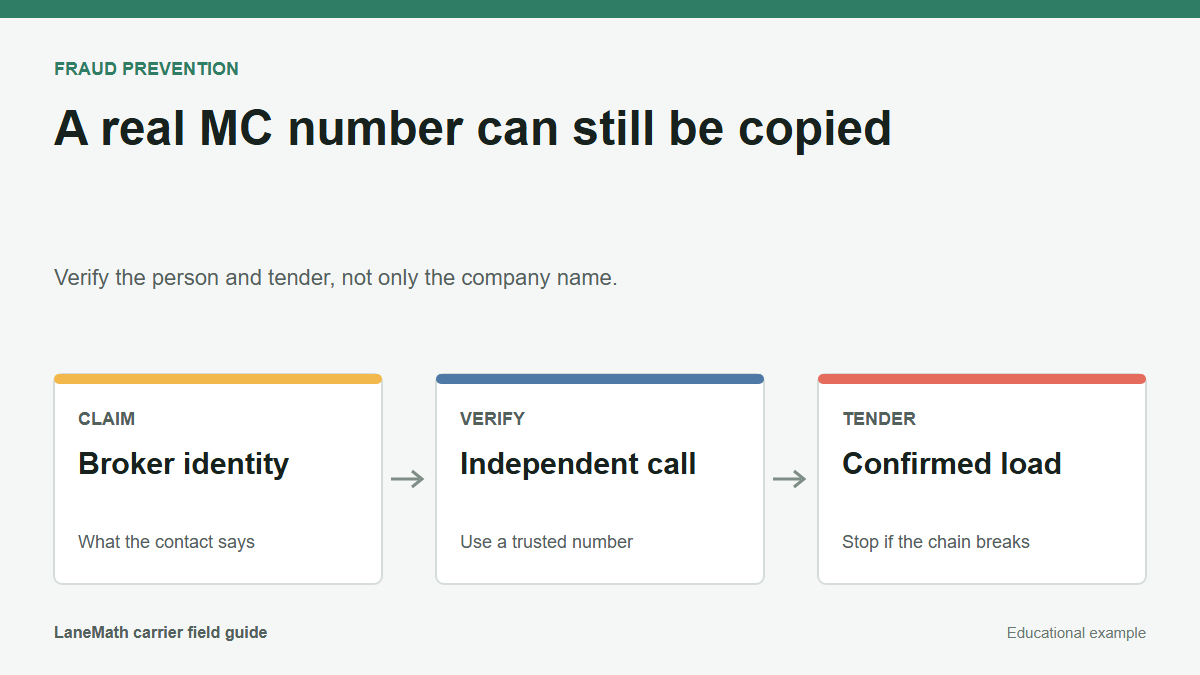
A valid MC number is not enough
Fraudulent contacts can copy the name and authority number of a legitimate broker. Looking up the number without comparing contact information only proves that the real company exists. Another error is calling the number in the suspicious email instead of using a trusted directory or an existing broker contact.
Keep the identity chain intact
Save the posting, original email headers when practical, contact numbers, confirmation, official lookup, and independent verification response. Keep the actual tendering broker and billing instructions together. If the load is rejected, retain enough information to prevent another dispatcher from repeating the same verification.
Example scenario
A confirmation uses a legitimate broker's logo and MC number, but the sender asks the carrier to invoice a different company. An independent call to the broker's published office confirms that the sender is not an employee. The matching logo never resolved the broken identity chain. The numbers and circumstances are educational examples; replace them with the actual route, written terms, costs, and operating limits for the load being considered.
What to check before booking
- Verify the broker and contact details against trusted records.
- Watch for mismatched email domains, rushed paperwork, or unclear shipper information.
- Contact the listed broker through verified channels when something does not line up.
- Write down any term that still depends on a broker reply before dispatch.
Common questions
How can a carrier tell if a load may be double-brokered?
Common patterns include a contact who cannot name the original shipper or load number, an email domain that does not match the broker on the rate confirmation, instructions to send the signed confirmation to a different company, and payment terms that reference a third party the carrier has not vetted.
What should a carrier do when double brokering is suspected?
Stop and verify independently. Contact the broker listed on the rate confirmation through a number from a trusted public source — not the phone number on the suspicious posting. If the original broker confirms the load, that confirmation should come directly from them.
Is it possible to be a victim of double brokering and still get paid?
It depends on the specific circumstances and who ends up holding the invoice. In cases where the original shipper or broker already paid someone else, the carrier who moved the freight may have limited collection options through the unauthorized re-broker. This is one reason FMCSA authority verification and identity confirmation matter before dispatch, not after delivery.
Does double brokering create cargo liability risk for the carrier who moved the freight?
It can. A carrier who accepts freight through a party without lawful authority to tender it may face questions about cargo insurance coverage and liability chain. Carriers who discover mid-load that the arrangement may not be legitimate should document what they know and consider contacting the shipper directly to clarify the load status.
References and methodology
- FMCSA Licensing and Insurance Authority Lookup - Federal Motor Carrier Safety Administration. Used here for: The official lookup path for active motor-carrier, broker, and freight-forwarder authority, insurance, and process-agent records.FMCSA directs authority checks to its Licensing and Insurance system. A public record does not verify that the person contacting a carrier represents the listed company. Last checked 2026-06-29.
- Broker Registration - Federal Motor Carrier Safety Administration. Used here for: Broker authority and registration background.Used as a public reference for broker basics. Last checked 2026-06-29.
- Payment-risk editorial methodology - LaneMath Editorial Desk. Used here for: Broker credit, quick pay, factoring, and documentation explanations that rely on practical workflow context.Used for educational payment workflow discussion. It is not financial, legal, credit, or factoring advice. Last checked 2026-06-29.