How to read a load board posting
A load-selection guide to reading posted freight details without over-trusting the headline rate, built around what to ask, what to verify, and what to write down before the truck moves.
Written and reviewed by LaneMath Editorial Team, with carrier workflow review from Dale Morrow where practical dispatch, paperwork, or lane-planning context is involved. Updated 2026-06-29. LaneMath pages use public references, example-only math, and conservative editorial review.
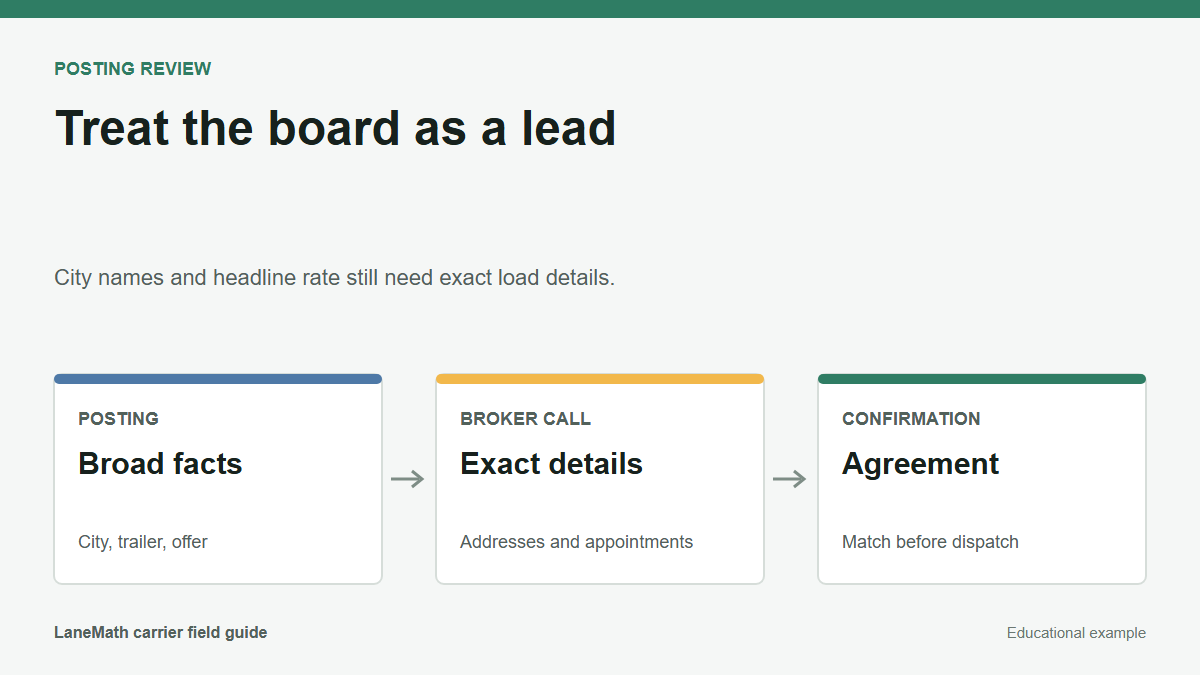
Posting-to-confirmation checks
Each line on a posting is a starting claim that should either be confirmed or marked unresolved.
| Signal | Why it matters | Next check |
|---|---|---|
| Only city names appear | A metro label can hide substantial approach and final-mile distance. | Ask for full addresses before final mileage calculation. |
| Rate is displayed | The number may be an opening offer or may omit fuel and extras. | Ask whether the rate is firm and all-in. |
| Appointment says FCFS | The facility can still have operating hours and last check-in. | Confirm the usable arrival range. |
| Contact information is unusual | Identity mismatch can indicate an error or impersonation risk. | Verify the broker through a trusted channel. |
Key takeaways
- Confirm pickup, delivery, commodity, weight, equipment, and appointment type.
- Ask whether the rate is all-in.
- Save written details before committing the truck.
Working frame for how to read a load board posting
A load-selection guide to reading posted freight details without over-trusting the headline rate, built around what to ask, what to verify, and what to write down before the truck moves. The first operating question is whether the subject changes money, time, equipment fit, payment exposure, or the truck's position after delivery. Keep those effects separate so one attractive number does not hide an unresolved condition.
Checks before the truck is committed
Confirm pickup, delivery, commodity, weight, equipment, and appointment type. Ask whether the rate is all-in. Save written details before committing the truck. Write down any term that still depends on a broker reply before dispatch. Confirm the exact commodity, weight, equipment, appointments, facility rules, and approval path that apply to this load rather than relying on a familiar lane or broker relationship.
Operating note
A load board posting is a lead, not the final agreement. Read it as a list of claims that must be verified: pickup city, actual facility, delivery city, appointment type, equipment, weight, commodity, rate, and broker identity. Short postings often hide the questions that matter most. If the board shows a good gross number but no appointment detail, the next step is a broker call, not an automatic booking.
Which posting details are only placeholders?
Ask for exact pickup and delivery locations, appointment type, commodity, weight, trailer requirement, and the broker's legal identity. City names may represent broad metro areas, and a posted rate may be an opening offer. Confirm which fields came from the shipper and which still need verification.
A posting is not a load agreement
Screenshots help preserve what was advertised, but they do not replace a signed confirmation. Another mistake is assuming a familiar city pair means a familiar facility. A pickup on the far side of a metro can add unpaid miles and hours that the board's city-to-city display does not show.
Save the posting before it changes
Keep the posting or reference number, broker name, contact, posted locations, equipment, and displayed rate. Add call notes and the final confirmation. When the written tender differs, the file should make the difference visible before the truck is dispatched.
Example scenario
A board lists Dallas to Houston with a dry van and a strong gross. The exact pickup is west of Fort Worth, the delivery is east of Houston, and the load is a live unload. The city-pair mileage understates both metro approaches, so the carrier recalculates before accepting. The numbers and circumstances are educational examples; replace them with the actual route, written terms, costs, and operating limits for the load being considered.
What to check before booking
- Confirm pickup, delivery, commodity, weight, equipment, and appointment type.
- Ask whether the rate is all-in.
- Save written details before committing the truck.
- Write down any term that still depends on a broker reply before dispatch.
Common questions
What is the most important thing to verify on a load board posting before calling?
Broker identity and contact information. Confirm the broker name on the posting matches a registered MC number and that the contact email domain corresponds to the same company. A posting with mismatched or unverifiable contact details deserves a closer look before investing call time.
Is the posted rate the final amount the carrier receives?
Not always. The posting may show a gross rate that excludes fuel, stops, or accessorials, or it may show an all-in figure. Carriers should ask whether the posted rate is all-in and verify on the written confirmation before signing. Verbal clarifications that differ from the document need to be resolved before dispatch.
What load board information is most often inaccurate or incomplete?
Pickup and delivery addresses are frequently listed as city-only, which can undercount actual approach miles and delivery distance significantly. Posted rates may not reflect the final negotiated amount. Appointment type labels — firm, FCFS, window — are sometimes simplified and need to be confirmed with the broker directly.
How should a carrier filter load board postings efficiently without calling on every load?
Apply the non-negotiable filters first: equipment match, general lane direction, and approximate mileage range. Within those results, scan for complete contact information, a gross rate worth the trip, and any obvious red flags in the posting details. This narrows the field before a single call is made. Calling on a load that fails a basic filter is less efficient than a quick visual screen of the posting.
References and methodology
- Broker Registration - Federal Motor Carrier Safety Administration. Used here for: Broker authority and registration background.Used as a public reference for broker basics. Last checked 2026-06-29.
- Broker negotiation editorial methodology - LaneMath Editorial Desk. Used here for: Broker call preparation, rate discussion, appointment changes, written confirmations, and walk-away decision examples.Used for practical negotiation education. It does not provide legal advice, pricing promises, or broker recommendations. Last checked 2026-06-29.