How to think about reload opportunities
A carrier-oriented look at checking whether delivery leaves the truck near usable freight, home time, or a costly repositioning move, with attention to empty miles, appointment pressure, cost exposure, and the next move after delivery.
Written and reviewed by LaneMath Editorial Team, with carrier workflow review from Dale Morrow where practical dispatch, paperwork, or lane-planning context is involved. Updated 2026-06-29. LaneMath pages use public references, example-only math, and conservative editorial review.
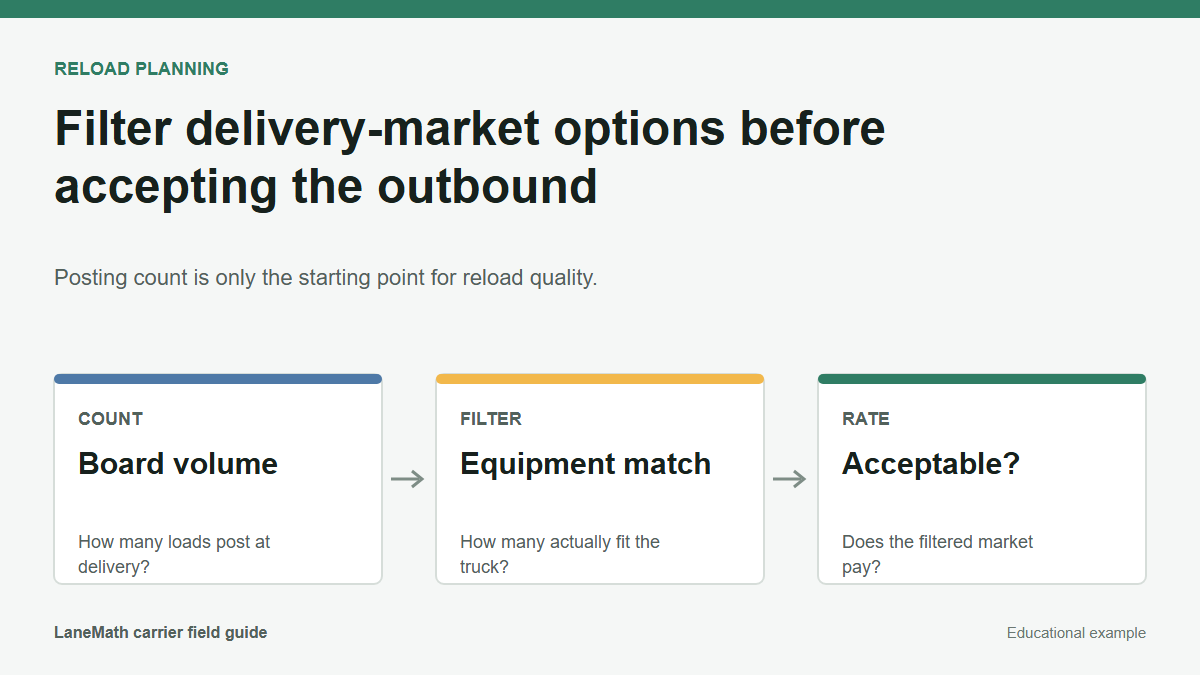
Reload quality assessment table
Reload quality is not determined by posting count alone — it depends on equipment fit, rate, distance, and timing.
| Signal | Why it matters | Next check |
|---|---|---|
| Delivery city has high board volume | High volume does not guarantee equipment-compatible or rate-acceptable freight. | Filter the delivery-city board by equipment type and acceptable rate range. |
| Reload is available but rate is low | A poor-rate reload may be better than empty repositioning, or may not be. | Compare reload gross against the empty-move alternative before accepting. |
| Reload requires significant deadhead from receiver | Pickup distance from the delivery receiver changes the effective economics. | Add that deadhead to the reload's total-mile estimate before comparing. |
| Market is thin on a Friday | Friday afternoon delivery can mean the next load is not available until Monday. | Account for day-of-week timing in the reload estimate for end-of-week deliveries. |
Key takeaways
- Look beyond the delivery city to the actual receiver location.
- Check hours available after unload before counting on a reload.
- Compare nearby markets against deadhead, appointment timing, and equipment fit.
Working frame for how to think about reload opportunities
A carrier-oriented look at checking whether delivery leaves the truck near usable freight, home time, or a costly repositioning move, with attention to empty miles, appointment pressure, cost exposure, and the next move after delivery. The first operating question is whether the subject changes money, time, equipment fit, payment exposure, or the truck's position after delivery. Keep those effects separate so one attractive number does not hide an unresolved condition.
Checks before the truck is committed
Look beyond the delivery city to the actual receiver location. Check hours available after unload before counting on a reload. Compare nearby markets against deadhead, appointment timing, and equipment fit. Write down any term that still depends on a broker reply before dispatch. Confirm the exact commodity, weight, equipment, appointments, facility rules, and approval path that apply to this load rather than relying on a familiar lane or broker relationship.
Operating note
Reload thinking belongs in the load decision, not just after delivery. A carrier who evaluates a load only on outbound economics may accept a delivery in a market where the return is consistently weak or seasonal. Checking what typically posts in the delivery city before booking adds one practical piece of information: whether the truck can cover its next move efficiently from that location. The estimate does not need to be exact — it needs to be realistic about whether freight in that corridor supports the truck's equipment type and payment standards.
Reload quality is not just volume
A market may have freight posted and still be a poor match for the truck. Look at equipment fit, pickup distance, appointment timing, payment terms, and whether the posted freight points toward the next useful direction. A reload opportunity is usable only when it fits the carrier's real day.
Can the truck actually use the freight near delivery?
Check equipment match, pickup radius, posting times, driver hours, broker standards, and the direction of likely outbound freight. A market can show volume that is too far away, too late, or unsuitable. Ask what the truck will do if the expected reload does not appear.
Posted volume can create false certainty
A screenshot taken before booking does not reserve a reload. Weekend timing, seasonal changes, and receiver delay can make visible freight unavailable when the truck empties. The outbound load should still be acceptable under a reasonable fallback, not only under the best reload outcome.
Record the primary and fallback position
Note the intended reload area, practical pickup radius, latest usable pickup time, and fallback move such as parking, home, or repositioning. After delivery, record where the truck actually reloaded. This distinguishes a planning error from normal market uncertainty.
Example scenario
A carrier sees several outbound loads 35 miles from the receiver, but they pick up before the delivery appointment ends. The market has freight, yet none of it is usable for this schedule. The reload plan shifts to a next-morning search and the outbound rate is judged accordingly. The numbers and circumstances are educational examples; replace them with the actual route, written terms, costs, and operating limits for the load being considered.
What to check before booking
- Look beyond the delivery city to the actual receiver location.
- Check hours available after unload before counting on a reload.
- Compare nearby markets against deadhead, appointment timing, and equipment fit.
- Write down any term that still depends on a broker reply before dispatch.
Common questions
How far out should a carrier start checking reload options before accepting a load?
Before accepting the outbound load is the right time. A quick check of what is typically posted in the delivery city for the carrier's equipment type gives a rough read on whether the market is usable. Load availability changes, but checking before booking prevents committing to a lane where repositioning costs are likely to erode the outbound rate.
Is a high-posting-count delivery city always a good reload market?
Not necessarily. High posting count matters less if the freight does not match the equipment type, the rates are consistently low for the corridor, or the pickup locations require significant deadhead from the delivery receiver. The practical question is whether the truck can find a usable next load within a reasonable time and distance from that specific delivery point.
How much time after delivery should a carrier plan before the next reload is available?
This varies significantly by market, day of week, and time of day. Urban industrial markets may have same-day reload options; rural or specialized markets may require overnight positioning. Carriers develop a sense for their regular delivery areas over time. For unfamiliar markets, a conservative estimate of four to six hours before a reload is confirmed and dispatched is a reasonable planning assumption.
How does the day of week affect reload quality from a delivery market?
Load board activity typically peaks on Tuesday through Thursday in most markets. A Friday afternoon delivery in a secondary market can mean waiting through the weekend for good freight. Carriers who account for day-of-week reload availability when planning weekly loads often avoid accepting Friday deliveries in markets where Monday pickup is the realistic next move.
References and methodology
- Load comparison example methodology - LaneMath Editorial Desk. Used here for: Example-only load comparison, weekly freight planning, reload uncertainty, and equipment-specific economics.Used for static planning examples based on carrier-entered assumptions, not pricing feeds or market forecasts. Last checked 2026-06-29.
- Lane planning methodology - LaneMath Editorial Desk. Used here for: Example-only lane economics, deadhead questions, accessorial checks, and planning prompts.Methodology source for practical examples. It is not freight pricing data, load board data, or a broker quote source. Last checked 2026-06-29.