Rate confirmation review guide
A paperwork-first guide to what carriers should review before signing the load agreement, including the written terms and records that matter before dispatch and after delivery.
Written and reviewed by LaneMath Editorial Team, with carrier workflow review from Dale Morrow where practical dispatch, paperwork, or lane-planning context is involved. Updated 2026-06-29. LaneMath pages use public references, example-only math, and conservative editorial review.
Carrier review note
Dale reviewed the confirmation workflow from the perspective of a small operation where dispatch and billing may be the same person. The guide therefore keeps the original, every written change, and the final billing version connected instead of treating the signature as the end of the file.
Confirmation review table
Read the document once for load facts, once for money, and once for the records billing will need.
| Signal | Why it matters | Next check |
|---|---|---|
| Location or date differs | The confirmation may describe a different service than the broker call. | Correct the lane or appointment before signing. |
| Accessorial language is silent | A verbal promise may be difficult to use during billing. | Ask for the applicable approval and proof rules. |
| Special instructions add work | Tracking, pallets, handling, or receipts can change time and exposure. | Price and confirm the added duty. |
| Revision arrives later | The driver and billing team may use different versions. | Label the superseded copy and distribute the final document. |
Key takeaways
- Match rate, dates, lane, equipment, commodity, and accessorial terms.
- Check payment terms and required paperwork.
- Request a revised confirmation for material changes.
Working frame for rate confirmation review guide
A paperwork-first guide to what carriers should review before signing the load agreement, including the written terms and records that matter before dispatch and after delivery. The first operating question is whether the subject changes money, time, equipment fit, payment exposure, or the truck's position after delivery. Keep those effects separate so one attractive number does not hide an unresolved condition.
Checks before the truck is committed
Match rate, dates, lane, equipment, commodity, and accessorial terms. Check payment terms and required paperwork. Request a revised confirmation for material changes. Write down any term that still depends on a broker reply before dispatch. Confirm the exact commodity, weight, equipment, appointments, facility rules, and approval path that apply to this load rather than relying on a familiar lane or broker relationship.
Operating note
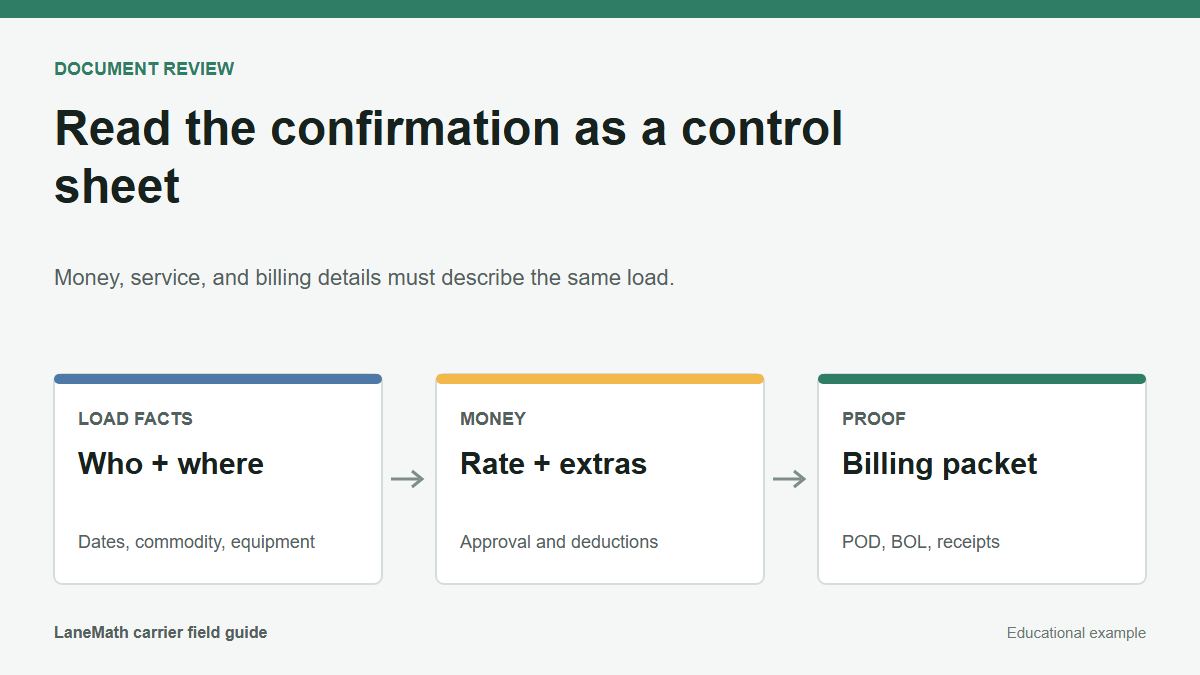
A rate confirmation review should happen before the carrier signs, not only after dispatch has started. Read the document like a control sheet: lane, dates, rate, equipment, commodity, appointments, special instructions, accessorial treatment, billing documents, and payment terms. The review is especially valuable when the broker call sounded clear but the written confirmation is shorter than the conversation. If a material detail is missing, ask for a revised confirmation rather than relying on a note in the dispatcher's memory.
The five-line review
Before signing, read five lines slowly: money, dates, locations, equipment, and special instructions. Most expensive surprises hide in one of those places. If the broker call and the document disagree, the document is the problem to fix before dispatch.
First read, not final check
The signing step — comparing the document against the specific truck, driver, and timeline being dispatched — is covered separately in the what-to-check-before-signing guide. This page is for the broad first read: checking whether the confirmation has everything it should while there is still time to ask for a revised version without creating dispatch pressure. Running both reviews is shorter than fixing a mismatch after the truck is already moving.
Does the document describe the load that was discussed?
Check parties, load number, dates, exact locations, commodity, weight, equipment, rate, appointments, accessorial terms, tracking, special instructions, and billing requirements. Compare each material item with the broker call. If the document is silent on an agreed term, ask for a corrected version before signing.
Fine print can change an ordinary load
A confirmation may add pallet exchange, driver assist, tracking penalties, receipt deadlines, or accessorial notice rules that were not discussed. Reading only the first page and rate line misses the terms most likely to affect billing. Saving only the unsigned copy creates a separate record problem.
Build a versioned confirmation file
Keep the received version, signed version, and every revision in time order. Add emails that explain a correction. The dispatcher and driver should work from the final version, while billing retains the history needed to explain why a rate, appointment, or charge changed.
Example scenario
The broker call promises detention after two hours, but the confirmation requires notice after one hour and says nothing about the rate. The carrier asks for the clock, amount, and notice method to be written before pickup rather than discovering the gap during invoicing. The numbers and circumstances are educational examples; replace them with the actual route, written terms, costs, and operating limits for the load being considered.
What to check before booking
- Match rate, dates, lane, equipment, commodity, and accessorial terms.
- Check payment terms and required paperwork.
- Request a revised confirmation for material changes.
- Write down any term that still depends on a broker reply before dispatch.
Common questions
What is the most common mistake when reviewing a rate confirmation?
Signing the confirmation without reading the accessorial terms. Detention, lumper, layover, TONU, and stop-off handling are often written with specific approval requirements that differ from what was discussed on the call. Signing before reading those terms can limit billing options later.
What should a carrier do when the confirmation differs from the verbal agreement?
Request a revised confirmation before dispatching. A phone call or message asking for the correction is useful but is not a substitute for the working document; both the broker and carrier need the corrected terms in writing.
How long does it typically take to review a rate confirmation properly?
A focused first read of a standard confirmation takes two to four minutes. That includes checking lane, dates, rate structure, equipment, commodity, accessorial language, and billing instructions. Longer documents with detailed shipper appendices or compliance clauses take more time. Rushing this step to save three minutes has a poor return when an error surfaces during billing.
Is a rate confirmation legally binding once signed?
A signed rate confirmation is generally treated as the governing agreement between the carrier and broker for that load. Disputes about verbal terms are typically resolved by reference to the signed document. Carriers should treat signing as a commitment to the written terms, not a formality after a phone agreement has already been made.
What should a carrier do when the broker pressures for a quick signature?
Take the time needed to read the confirmation regardless of pressure. A load that cannot hold a two-minute review period before dispatch is a load with a pressure problem that may show up elsewhere. Pressure to skip document review has been a consistent pattern in load fraud scenarios.
References and methodology
- Broker Registration - Federal Motor Carrier Safety Administration. Used here for: Broker authority and registration background.Used as a public reference for broker basics. Last checked 2026-06-29.
- Rate confirmation educational reference - LaneMath Editorial Desk. Used here for: Educational discussion of rate confirmation review, revised confirmations, written approval, and document connections.Used for document literacy. It is not legal advice and does not replace professional review. Last checked 2026-06-29.