How to handle a rate reduction request
A practical risk review for reviewing a broker request to reduce pay after a load detail changes or a service issue is alleged, written for carriers that need cleaner broker checks and billing records before committing a truck.
Written and reviewed by LaneMath Editorial Team, with carrier workflow review from Dale Morrow where practical dispatch, paperwork, or lane-planning context is involved. Updated 2026-06-29. LaneMath pages use public references, example-only math, and conservative editorial review.
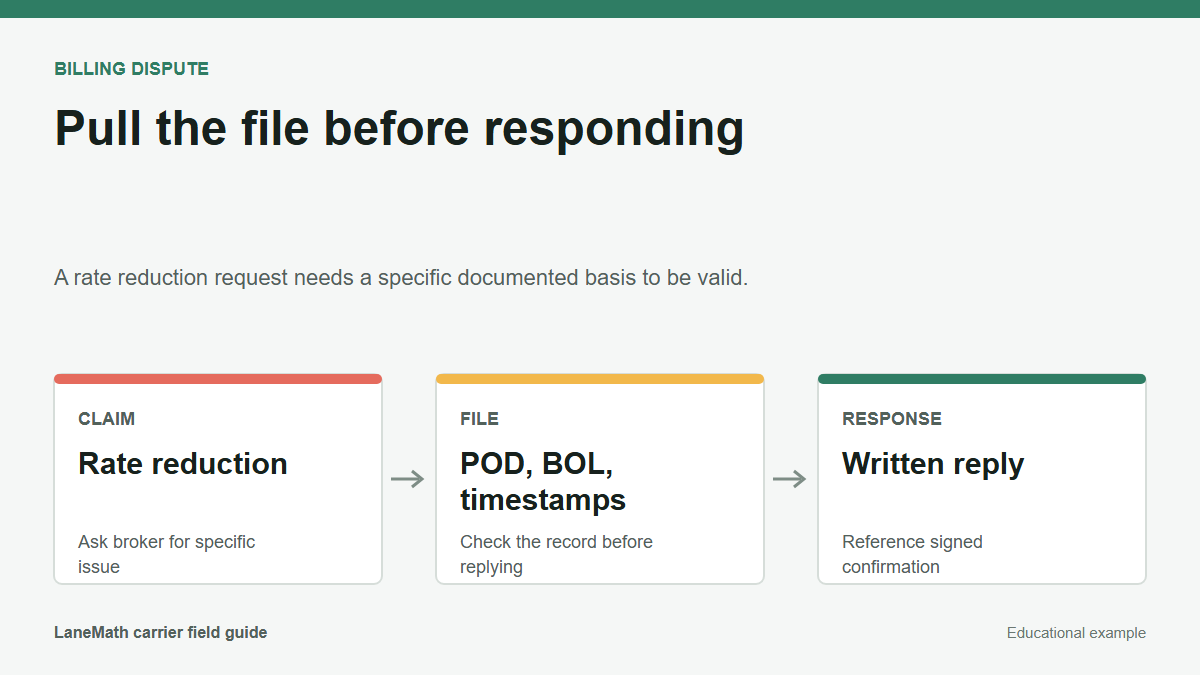
Rate-reduction response table
A documented rate reduction request should be met with a documented, factual response before any agreement is reached.
| Signal | Why it matters | Next check |
|---|---|---|
| Broker cites a service issue | The claim may or may not be supported by documents in the load file. | Pull the confirmation, BOL, POD, and timestamps before responding. |
| No specific event is named | A general complaint is different from a documented service failure. | Ask the broker to identify the specific issue and document it. |
| Short pay arrives with the settlement | A deduction without a prior request changes the response options. | Dispute in writing immediately with a reference to the signed confirmation. |
| The broker offers a future load instead | A verbal future credit is not payment for the current invoice. | Decline to trade a current billing right for an unwritten future promise. |
Key takeaways
- Separate documented service facts from a general rate complaint.
- Compare the request against the signed or revised confirmation.
- Keep communication factual and preserve the billing file.
Working frame for how to handle a rate reduction request
A practical risk review for reviewing a broker request to reduce pay after a load detail changes or a service issue is alleged, written for carriers that need cleaner broker checks and billing records before committing a truck. The first operating question is whether the subject changes money, time, equipment fit, payment exposure, or the truck's position after delivery. Keep those effects separate so one attractive number does not hide an unresolved condition.
Checks before the truck is committed
Separate documented service facts from a general rate complaint. Compare the request against the signed or revised confirmation. Keep communication factual and preserve the billing file. Write down any term that still depends on a broker reply before dispatch. Confirm the exact commodity, weight, equipment, appointments, facility rules, and approval path that apply to this load rather than relying on a familiar lane or broker relationship.
Separate facts from pressure
A rate reduction request should be sorted into facts, documents, and opinions. Facts include dates, arrival times, service notes, exceptions, and written instructions. Documents include confirmations, revised confirmations, BOL, POD, and messages. Pressure language is not the same as proof. Keep the reply factual and tied to the load file.
What written term supports the proposed deduction?
Ask for the specific service issue, evidence, contract or confirmation clause, amount, and calculation. Compare it with appointment records, driver messages, BOL, POD, and any broker instruction. A request to reduce rate should be evaluated as a documented claim, not as a general statement that the customer is unhappy.
Arguing before assembling the timeline
A defensive reply can overlook a real exception or make a weak deduction harder to discuss. The opposite error is agreeing on the phone before seeing the basis in writing. Separate facts, documents, and disputed opinions before accepting or rejecting any revised amount.
Preserve the original agreement
Keep the signed confirmation, proposed reduction, stated reason, dispatch timeline, facility records, BOL, POD, messages, and final resolution. If the amount changes, require a revised confirmation or settlement record that identifies the adjustment.
Example scenario
A broker requests a $300 reduction for late delivery. GPS and check-call notes show the receiver moved the appointment by four hours after pickup. The carrier replies with the timeline and written appointment change before discussing whether any deduction is justified. The numbers and circumstances are educational examples; replace them with the actual route, written terms, costs, and operating limits for the load being considered.
What to check before booking
- Separate documented service facts from a general rate complaint.
- Compare the request against the signed or revised confirmation.
- Keep communication factual and preserve the billing file.
- Write down any term that still depends on a broker reply before dispatch.
Common questions
Can a broker reduce the rate after the load is delivered?
A broker may request a rate reduction, but whether the carrier agrees depends on the written confirmation, the service issue being cited, and whether the claim is documented. Carriers should separate what is documented from what is a general complaint, and compare any request against the signed confirmation.
Should a carrier accept a rate reduction without reviewing the documents first?
No. Before responding, the carrier should review the signed rate confirmation, BOL, POD, timestamps, and any written communication about the service issue. A clear billing file is the foundation of any discussion about a post-delivery rate change.
What is the difference between a legitimate service claim and a general rate dispute?
A legitimate service claim cites a specific, documentable event — a late delivery with a written complaint, a damaged shipment with a documented receiver exception, a missed appointment confirmed in writing. A general rate dispute says the carrier did not perform without pointing to a specific documented failure. Carriers should ask for the specific written record before responding to any reduction request.
Is the carrier required to respond immediately when a broker requests a rate reduction?
No. Taking time to review the load file, understand the claim, and consult with billing or a carrier advisor is a reasonable step before responding. A quick acceptance to avoid conflict may waive a valid billing position. A carrier can acknowledge receipt and respond within a defined timeframe while the documentation is reviewed.
References and methodology
- Broker negotiation editorial methodology - LaneMath Editorial Desk. Used here for: Broker call preparation, rate discussion, appointment changes, written confirmations, and walk-away decision examples.Used for practical negotiation education. It does not provide legal advice, pricing promises, or broker recommendations. Last checked 2026-06-29.
- Rate confirmation educational reference - LaneMath Editorial Desk. Used here for: Educational discussion of rate confirmation review, revised confirmations, written approval, and document connections.Used for document literacy. It is not legal advice and does not replace professional review. Last checked 2026-06-29.