Quick pay vs factoring
A practical risk review for two common ways carriers receive freight payment faster, written for carriers that need cleaner broker checks and billing records before committing a truck.
Written and reviewed by LaneMath Editorial Team, with carrier workflow review from Dale Morrow where practical dispatch, paperwork, or lane-planning context is involved. Updated 2026-06-29. LaneMath pages use public references, example-only math, and conservative editorial review.
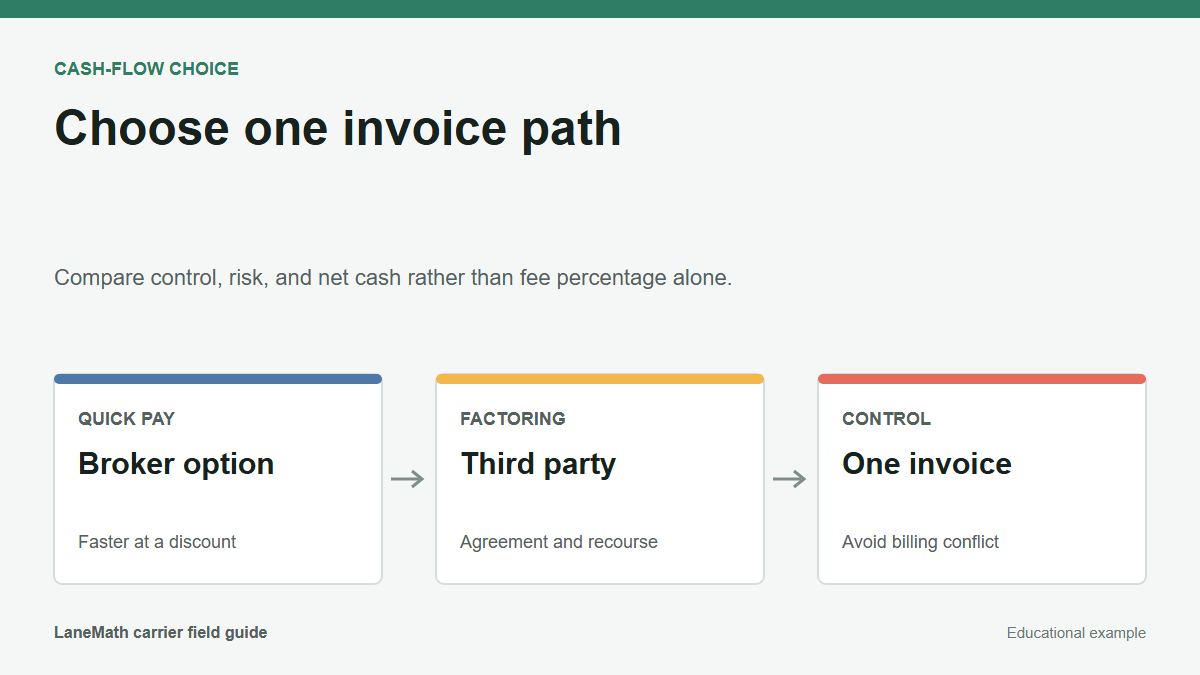
Cash-flow option comparison
A fair comparison uses net cash, timing, control, and recourse rather than the advertised fee alone.
| Signal | Why it matters | Next check |
|---|---|---|
| Broker offers quick pay | The broker controls the faster option and its document requirements. | Calculate the discount against the full invoice. |
| Factor has a notice of assignment | The factor may be the only party allowed to invoice the broker. | Check whether quick pay conflicts with the agreement. |
| Fee percentages are close | Reserve, recourse, minimums, and collections can change total cost. | Compare expected cash received and remaining risk. |
| Invoice has an exception | Fast-payment timing may stop until the document or dispute is resolved. | Ask how each option handles non-standard invoices. |
Key takeaways
- Compare fees, recourse terms, notice requirements, and broker eligibility.
- Make sure only one party invoices the broker.
- Ask your factoring company how exceptions are handled.
Working frame for quick pay vs factoring
A practical risk review for two common ways carriers receive freight payment faster, written for carriers that need cleaner broker checks and billing records before committing a truck. The first operating question is whether the subject changes money, time, equipment fit, payment exposure, or the truck's position after delivery. Keep those effects separate so one attractive number does not hide an unresolved condition.
Checks before the truck is committed
Compare fees, recourse terms, notice requirements, and broker eligibility. Make sure only one party invoices the broker. Ask your factoring company how exceptions are handled. Write down any term that still depends on a broker reply before dispatch. Confirm the exact commodity, weight, equipment, appointments, facility rules, and approval path that apply to this load rather than relying on a familiar lane or broker relationship.
Operating note
Quick pay and factoring solve different cash-flow problems. Quick pay usually comes from the broker and may discount the invoice for faster payment. Factoring usually involves a third party and may add notices, reserves, recourse terms, and broker eligibility rules. A carrier should compare total fee, control of collections, paperwork flow, and whether the broker can be billed by only one party. Confusion here can delay payment even when the load delivered cleanly.
The billing conflict to avoid
The worst version is not the fee; it is confusion over who owns the invoice. If the carrier chooses quick pay while a factoring company expects to invoice the same broker, payment can slow down instead of speed up. Decide the payment path before billing, then keep the proof with the load file.
Who controls the invoice and collection?
Compare fee, payment timing, recourse, reserve, notice requirements, broker eligibility, and responsibility for collections. Ask whether the factoring agreement permits the broker's quick-pay option. The carrier needs one clear invoice path before submitting anything.
Fast payment can create duplicate billing
Selecting quick pay on a broker portal while a factor has a notice of assignment can send two parties toward the same invoice. Comparing only headline fees also misses reserves, minimums, recourse exposure, and administrative time. The cheaper percentage is not always the lower total cost.
Document the chosen payment path
Keep the broker's quick-pay terms or factoring agreement reference, fee calculation, notice of assignment when applicable, invoice, delivery packet, and payment confirmation. A dispatch note should state who will invoice so operations does not casually select another option in the broker portal.
Example scenario
A broker offers two-day quick pay at 3 percent. The carrier's factor charges 2.5 percent but holds a reserve and treats the broker as recourse. The useful comparison includes cash received, timing, risk, and who handles collection, not just 3 versus 2.5. The numbers and circumstances are educational examples; replace them with the actual route, written terms, costs, and operating limits for the load being considered.
What to check before booking
- Compare fees, recourse terms, notice requirements, and broker eligibility.
- Make sure only one party invoices the broker.
- Ask your factoring company how exceptions are handled.
- Write down any term that still depends on a broker reply before dispatch.
Common questions
Is quick pay the same as factoring?
No. Quick pay is usually a broker payment option for faster pay at a fee. Factoring usually involves a third party buying or advancing against invoices under separate terms.
What is the main billing risk with quick pay and factoring?
The carrier should avoid duplicate or conflicting billing. Confirm who invoices the broker, what notices are required, and whether the broker is eligible under the factoring agreement.
What percentage does quick pay typically cost, and is it worth it?
Quick pay fees vary by broker but commonly run between 1.5 and 5 percent of the invoice. Whether that cost is worthwhile depends on the carrier's cash needs, other financing options, and how the fee compares to a factoring arrangement already in place. A carrier with stable cash flow may find standard net-30 pay cheaper overall.
Can a carrier switch between quick pay and factoring load by load?
Practically, yes on the quick pay side — it is usually a per-load election. On the factoring side, it depends on the agreement. Many factoring contracts require all eligible invoices to go through the factor, with limited exceptions. The carrier should read the factoring agreement before using broker quick pay on any load where factoring applies.
References and methodology
- Payment-risk editorial methodology - LaneMath Editorial Desk. Used here for: Broker credit, quick pay, factoring, and documentation explanations that rely on practical workflow context.Used for educational payment workflow discussion. It is not financial, legal, credit, or factoring advice. Last checked 2026-06-29.