Broker payment terms explained
A practical risk review for how standard terms, paperwork, and deductions can affect cash flow, written for carriers that need cleaner broker checks and billing records before committing a truck.
Written and reviewed by LaneMath Editorial Team, with carrier workflow review from Dale Morrow where practical dispatch, paperwork, or lane-planning context is involved. Updated 2026-06-29. LaneMath pages use public references, example-only math, and conservative editorial review.
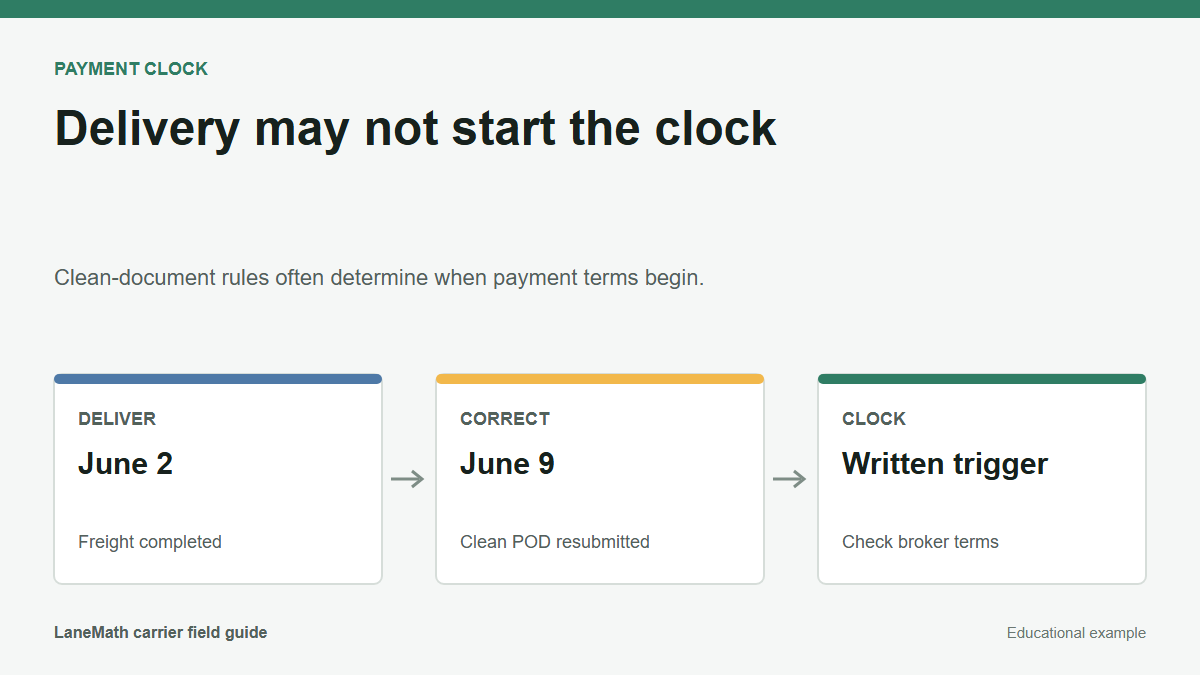
Payment-clock checkpoints
The written trigger and a complete billing packet determine when a carrier can reasonably follow up.
| Signal | Why it matters | Next check |
|---|---|---|
| Terms say net 30 | The phrase may still depend on receipt of clean documents. | Identify the event that starts day one. |
| POD is rejected | The broker may treat the invoice as incomplete until a readable copy arrives. | Correct the file and retain the resubmission receipt. |
| Portal shows pending | Upload does not always mean the packet passed validation. | Check acceptance status and any missing-document notice. |
| Payment is short | A deduction or missing accessorial may require a separate document trail. | Compare remittance with the final confirmation and approvals. |
Key takeaways
- Know the payment clock and paperwork requirements.
- Confirm quick pay fees before choosing faster payment.
- Track POD, invoice, lumper receipts, and revised confirmations.
Working frame for broker payment terms explained
A practical risk review for how standard terms, paperwork, and deductions can affect cash flow, written for carriers that need cleaner broker checks and billing records before committing a truck. The first operating question is whether the subject changes money, time, equipment fit, payment exposure, or the truck's position after delivery. Keep those effects separate so one attractive number does not hide an unresolved condition.
Checks before the truck is committed
Know the payment clock and paperwork requirements. Confirm quick pay fees before choosing faster payment. Track POD, invoice, lumper receipts, and revised confirmations. Write down any term that still depends on a broker reply before dispatch. Confirm the exact commodity, weight, equipment, appointments, facility rules, and approval path that apply to this load rather than relying on a familiar lane or broker relationship.
Know when the clock starts
Payment terms are more useful when the carrier knows what starts the clock. Some brokers count from invoice receipt, some from clean paperwork, and some require a portal submission or specific billing email. A carrier that knows the trigger can build the packet correctly instead of guessing after delivery.
What starts the payment clock?
Ask whether terms begin at delivery, receipt of a clean invoice, portal acceptance, or approval of all supporting documents. Confirm where invoices go, which documents are mandatory, how quick pay changes the process, and who handles a disputed or short-paid item.
Net 30 does not always mean 30 days from delivery
If the broker considers the packet incomplete, the payment clock may not start when the carrier expects. Common delays include unreadable PODs, missing rate revisions, wrong invoice references, and receipts sent to the dispatcher but not billing. The label alone does not describe the workflow.
Keep proof of a complete submission
Save the invoice, signed confirmation, BOL, POD, receipts, approvals, submission date, and portal or email receipt. Note any rejection and resubmission. When payment is late, a documented clean-packet date gives the carrier a more useful starting point than the delivery date alone.
Example scenario
A load delivers June 2, but the broker rejects the invoice on June 8 because the POD image cuts off a signature. The carrier resubmits June 9. Whether net 30 starts on June 2 or June 9 depends on the written terms and clean-packet requirements. The numbers and circumstances are educational examples; replace them with the actual route, written terms, costs, and operating limits for the load being considered.
What to check before booking
- Know the payment clock and paperwork requirements.
- Confirm quick pay fees before choosing faster payment.
- Track POD, invoice, lumper receipts, and revised confirmations.
- Write down any term that still depends on a broker reply before dispatch.
Common questions
What does net 30 mean for carriers?
Net 30 means the broker's payment clock starts after the broker receives all required billing documents — typically the signed rate confirmation, BOL, and POD. Carriers should confirm when the clock starts, what documents are required, and how disputes or short-pay situations are handled.
Can a carrier use both quick pay and factoring on the same load?
Generally not without coordination. Using both on the same load typically creates a billing conflict. The carrier should confirm with the factoring company whether the broker is eligible and which party will invoice. Submitting two invoices for the same load can result in payment disputes.
When does the net 30 clock typically start — delivery date or invoice date?
The trigger varies by broker. Some start the clock on the delivery date, others start it when a clean billing packet is received, and some use a portal submission date. The rate confirmation or broker onboarding paperwork should state this. When it is unclear, asking directly before dispatch produces a cleaner answer than trying to reconstruct it after a late payment.
What can a carrier do if a broker pays late beyond the stated terms?
The practical first step is a written inquiry — email or message referencing the load number, delivery date, billing date, and stated terms. If that does not resolve it, a collections call to the broker's accounting department with the invoice and delivery documentation attached tends to produce faster results than a general complaint. Long-unresolved payment issues can also be reported to FMCSA.
Should payment terms affect whether a carrier books a load?
Yes, especially for carriers with tight cash flow. A higher-gross load with slow or vague payment terms may produce worse weekly cash flow than a slightly lower-gross load from a broker with predictable net-7 or quick pay. Payment terms are part of the load economics, not a separate administrative detail.
References and methodology
- Broker Registration - Federal Motor Carrier Safety Administration. Used here for: Broker authority and registration background.Used as a public reference for broker basics. Last checked 2026-06-29.
- Payment-risk editorial methodology - LaneMath Editorial Desk. Used here for: Broker credit, quick pay, factoring, and documentation explanations that rely on practical workflow context.Used for educational payment workflow discussion. It is not financial, legal, credit, or factoring advice. Last checked 2026-06-29.